Automation
n8n + AutomateNexus CRM
Webhook node in, HTTP Request node out, self-hosted or cloud.

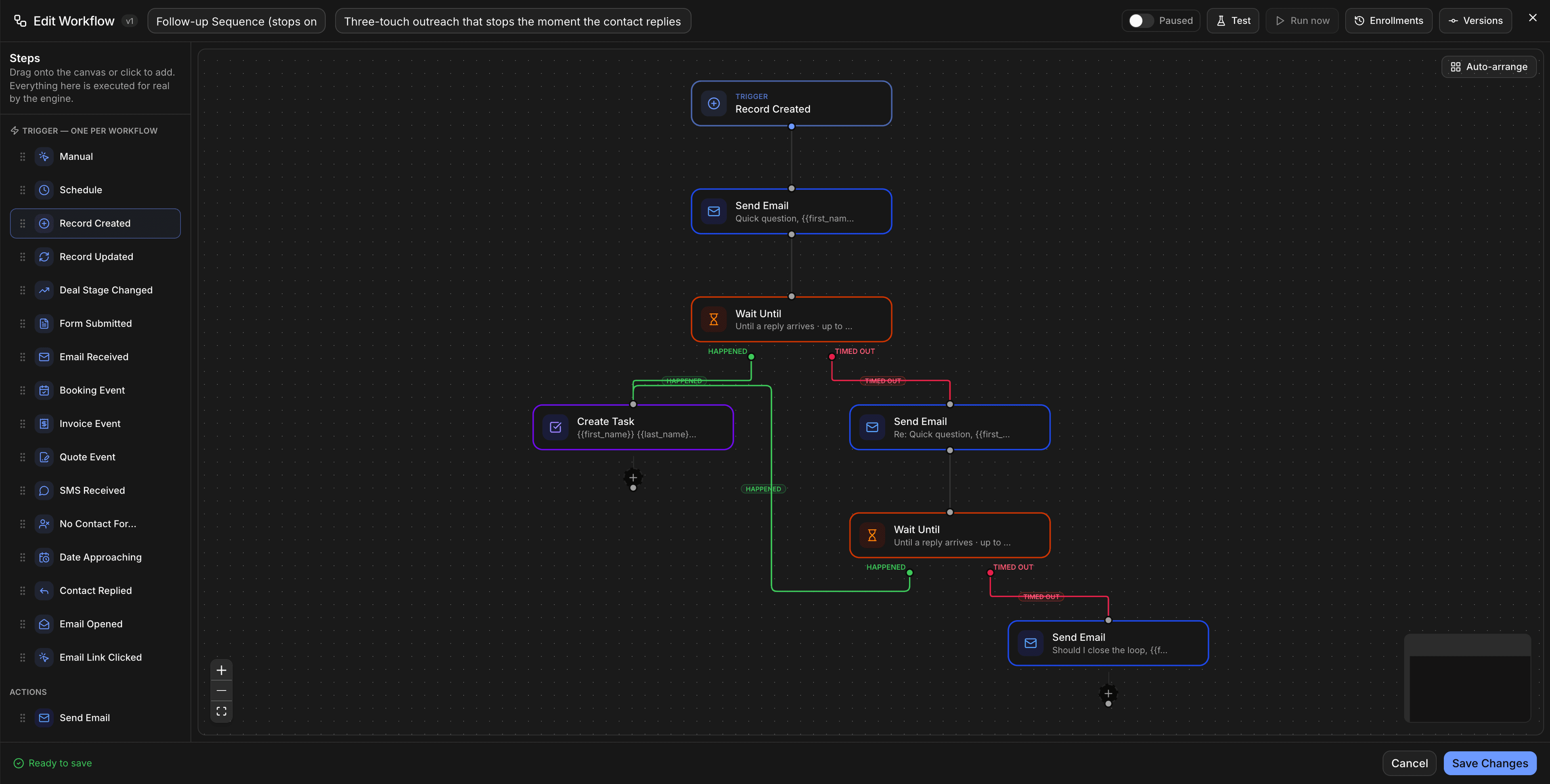
n8n, wired into your pipeline.
- 01
Webhook node in, HTTP Request node out
An n8n Webhook node receives signed CRM events; an HTTP Request node with Header Auth (Authorization: Bearer YOUR_API_KEY) reads and writes records through the REST API.
- 02
Self-hosted or cloud
Run n8n on your own server or at app.n8n.io. The CRM only needs an HTTPS URL it can reach, which is what a reverse proxy in front of a self-hosted instance provides.
- 03
Twelve CRM events, full records
Contacts, companies, customers, tasks, deals (including stage changes) and form submissions, each delivery carrying the full record and, for updates, the previous version.
Connected in three steps.
- Step 01
Add a Webhook node in n8n
Create a workflow, add a Webhook node and copy its URL.
- Step 02
Create the webhook in the CRM
Under Settings → Integrations → Developer → Webhooks, paste the n8n URL, tick the events (for example contact.created, deal.updated) and click Create webhook. Click Test to send a signed sample.
- Step 03
Write back with HTTP Request
Add an HTTP Request node: GET, POST, PUT or DELETE against your API base URL plus the resource, Authentication set to Header Auth with the Authorization header. Activate the workflow.
Built to be left alone.
Retries you can see
A failed delivery is retried after 1, 5 and 30 minutes, four attempts in all with a 10-second timeout each. The delivery log keeps the last 50 deliveries for 30 days with status, response code, response time and the exact payload sent.
Signed, rotatable secrets
Every delivery carries an X-Webhook-Signature header (t=timestamp, v1=HMAC-SHA256 of the timestamp and raw body). The secret is shown once, stored encrypted, and can be rotated from the webhook's row.
120 requests a minute
The REST API allows 120 requests a minute per key and answers 429 with a Retry-After header beyond that. Webhooks and full API access are on all four plans.
Twelve events out, the whole API in.
Out of the CRM: twelve events
Tick any of contact.created, contact.updated, deal.created, deal.updated, deal.stage_changed, customer.created, customer.updated, company.created, company.updated, task.created, task.updated and form.submitted. Each payload carries the event, when it happened, your organization id, the full record as it now stands and, for updates, the record as it was, so n8n can compare a deal's old and new stage without another call.
Into the CRM: the REST API
Create, read, update and delete /contacts, /customers, /deals, /tasks, /notes and /invoices, plus /search, /bulk, /export, /analytics and /schema, with Authorization: Bearer YOUR_API_KEY. The API Documentation page (Docs button next to your API endpoint) lists every payload.
The quick-send URL
For simple 'send data to the CRM' steps, each platform card under Settings → Integrations → Automation shows an inbound URL ending in /webhooks/n8n. POST an event_type and a data object with your key in an x-api-key header; it accepts contact.created, contact.updated (matched by email or id), deal.created, customer.created and activity.created, and stamps n8n as the record's source.
Running n8n against the CRM.
No dedicated n8n node
There is no AutomateNexus CRM node in the n8n catalogue; the generic Webhook and HTTP Request nodes cover triggers and actions, and the API Documentation page lists every endpoint and payload.
Self-hosting checklist
Make the instance reachable from the internet over HTTPS (Nginx or Caddy in front), lock down access to n8n itself, and keep your CRM API key in an environment variable or n8n credential rather than inside a workflow.
Verify the signature
For a hardened endpoint, check the X-Webhook-Signature header in a Code node: HMAC-SHA256 of the timestamp, a period and the raw body with your signing secret, compared against the v1 value.
n8n and AutomateNexus CRM, answered.
No. AutomateNexus CRM does not publish an app in the n8n directory. You connect with the Webhook node for triggers and the HTTP Request node for actions, which takes a webhook URL and an API key rather than a one-click authorisation, and works on every plan.
Twelve: contact.created, contact.updated, deal.created, deal.updated, deal.stage_changed, customer.created, customer.updated, company.created, company.updated, task.created, task.updated and form.submitted. You choose them per webhook under Settings → Integrations → Developer → Webhooks, and a Test button sends a real, signed webhook.test delivery so n8n can learn the payload shape.
Through the REST API with an API key from Settings → Integrations → Developer → API keys: POST or PUT to your API base URL plus /contacts, /deals, /tasks and the other resources, JSON body, Authorization: Bearer header. For simple inserts the quick-send URL takes an event_type and a data object with the key in an x-api-key header.
Endpoints must be HTTPS. Each delivery is signed with HMAC-SHA256 over the timestamp and raw body (the X-Webhook-Signature header, t= and v1=), the secret is generated server-side and shown once, and you can rotate it at any time; the old secret stops working immediately.
The delivery is retried after 1, 5 and 30 minutes (four attempts, 10-second timeout each). The webhook row shows consecutive failures and the time of the last success and failure, and the delivery log keeps 50 deliveries for 30 days.
Usually not. The built-in workflow builder and booking workflows send email and SMS, create tasks, log activities and call webhooks on their own; reach for n8n when the other end of the automation lives outside the CRM.
Put n8n to work.
Start your 7-day free trial and connect n8n on day one. No credit card, no middleware.