CRM for Ecommerce
Your store knows orders. Your CRM should know customers.
Repeat buyers are the margin. AutomateNexus CRM ties Stripe revenue to real customer records, scores who's likely to buy again, and lets the agents run win-back and follow-up outreach automatically.
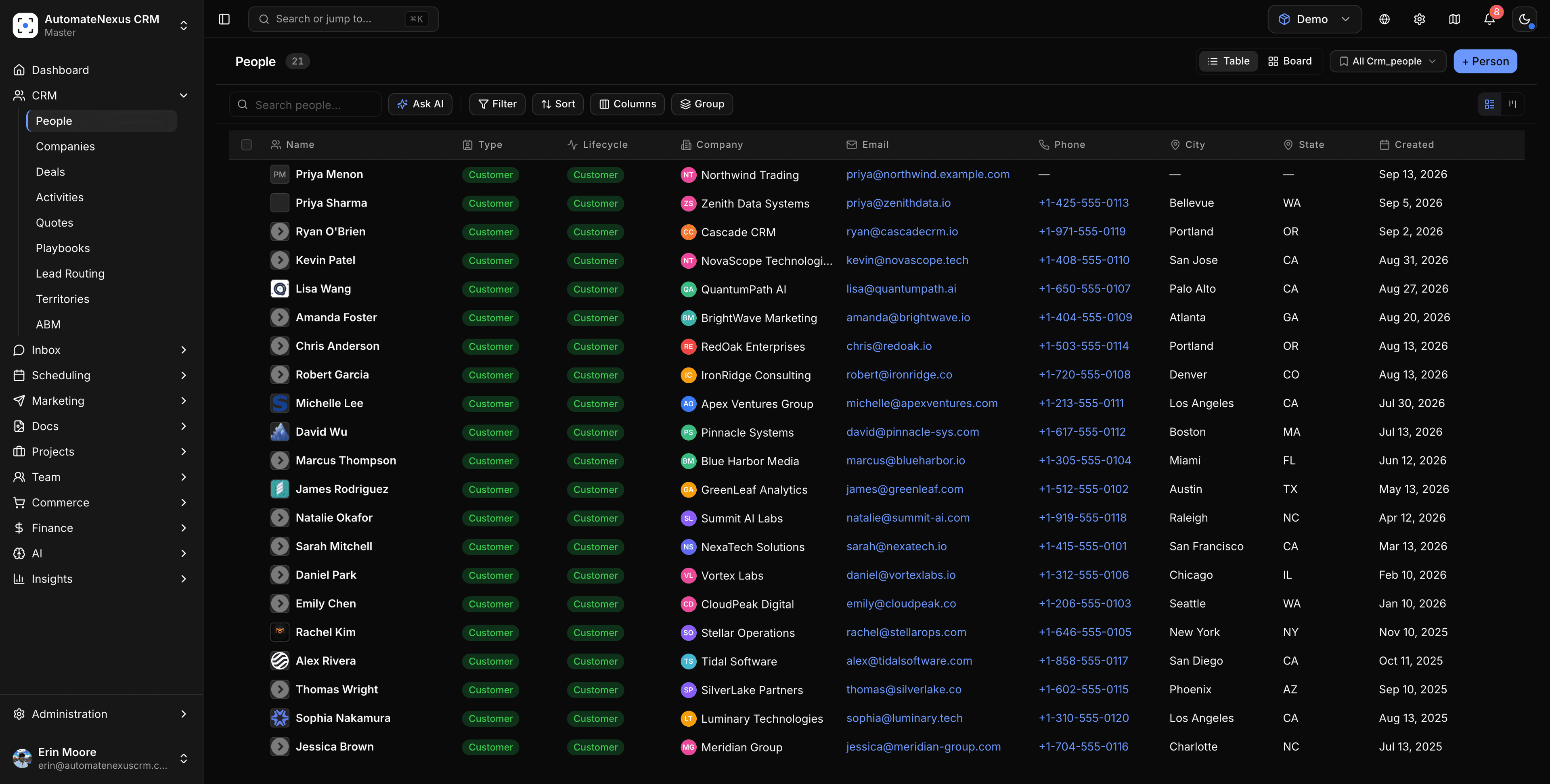

Where ecommerce pipelines leak.
- 01
Buyers are rows, not relationships
Order history lives in the store platform; nobody owns the follow-up that turns a first order into a second.
- 02
Win-backs never get sent
Lapsed-customer outreach is everyone's plan and no one's job.
- 03
Wholesale/B2B runs on email threads
Bigger accounts need quotes, invoices, and a pipeline — spreadsheets don't cut it.
Built for how ecommerce brands actually sell.
Revenue on the record
Stripe payments reconcile to customers and deals automatically, so lifetime value is visible per relationship.
Win-backs that run
Agents flag lapsed customers and draft the win-back outreach — approve once, and the sequence runs.
B2B pipeline built in
Quotes, invoices, and stage-by-stage pipeline for wholesale and key accounts, with e-commerce features native to the CRM.
Know your next month
Forecasting projects revenue from your own history, with trend and seasonality.
How an ecommerce pipeline runs.
How a store turns orders into relationships on AutomateNexus CRM.
- 01
Orders become customers
Stripe, PayPal, and Square payments, and orders from the built-in storefront, create or update the customer record with revenue attached. Shopify and WooCommerce orders arrive through Zapier, Make, or n8n.
- 02
Post-purchase, on autopilot
A sequence thanks the buyer, asks for the review, and suggests the next product, by email and, where they've opted in, SMS or WhatsApp.
- 03
Segments from real data
Repeat buyers, high-value customers, and lapsed customers are segments, not exports, and campaigns target them directly.
- 04
Win-backs that run
Agents flag customers past their usual reorder window and draft the win-back for approval.
- 05
B2B and wholesale
Quotes, invoices, discount codes, and a pipeline for key accounts, with the portal for reorders.
The agents that work an ecommerce pipeline.
Every plan includes Karrie and seven specialists. These are the ones ecommerce brands lean on most, with your approval on anything sensitive and an audit trail on everything.
See how the agents work- A1KarrieAI Co-PilotAnswers questions about customers and orders with citations and drafts win-back emails for approval.
- A2MarketingOperatorBuilds campaigns and segments and schedules social posts.
- A3SupportResolverDrafts replies to order questions in the unified inbox.
- A4OpsCoordinatorHandles tasks, meetings and workflows across channels.
- A5AnalyticsForecasterForecasts revenue from live pipeline and repeat-purchase patterns.
The tools ecommerce brands already use.
- 01StripeInvoices, bookings, products and forms paid through Stripe Checkout.
- 02PayPalAccept PayPal on invoices and bookings.
- 03SquareTake Square payments on invoices and bookings.
- 04BrevoCampaign sending through your Brevo account.
- 05MailchimpSync CRM contacts to audiences and engagement back.
- 06SendGridDeliver one-to-one and campaign email via SendGrid.
- 07WhatsAppWhatsApp through your Twilio sender, in the same inbox as SMS and email.
- 08FacebookSchedule and publish Page posts from the social queue.
- 09InstagramPlan, publish, and track Instagram posts.
- 10ZapierTrigger Zaps from twelve CRM events and write records back through the REST API.
- 11MakeWebhooks trigger your scenarios; the HTTP module writes records back.
What to look for in a CRM for ecommerce brands.
Whether or not you choose us, hold every vendor to these.
Revenue on the customer record
Lifetime value per person, not per order. Payments from every processor should reconcile to one customer so win-backs target the buyers worth winning back.
Sending limits you can live with
Hosted campaign sending is quota-based on every platform. Ours are on the pricing page, with add-on packs; check any vendor's limits against your list size before you migrate.
Social in the same tool
Schedule to Facebook, Instagram, TikTok, LinkedIn, X, and Google Business Profile from one queue, with replies flowing into the same inbox as order questions.
Store connectors, honestly
Native Shopify and WooCommerce connectors are not here yet. Orders come in through payment events or automation platforms; make sure any vendor is equally clear about what's native.
Support in the same inbox
Order questions, review replies, and win-backs shouldn't live in three tools. One inbox with AI drafts keeps response times down without more staff.
CRM for ecommerce brands, answered.
Yes — natively. Charges and payment links reconcile to customer records and deals automatically, so revenue and relationships stay in one place.
Agents watch for lapsed customers, draft the outreach in your voice, and run the sequence once approved — across email and SMS.
Both. DTC teams use scoring and win-backs; wholesale and B2B teams get a real pipeline with quotes and invoicing built in.
From $49/month with unlimited contacts — no charge per customer record and no per-seat AI fee.
Not natively today. Orders reach the CRM through Stripe, PayPal, or Square payment events, the built-in storefront, or Zapier, Make, and n8n for Shopify and WooCommerce.
Campaigns send through your own email provider, such as Mailgun, Postmark or Google Workspace, so your provider's limits apply, not ours. Prefer us to host your sending? It's an add-on you can buy inside the app, on any plan. One-to-one email goes through your connected Gmail or Outlook.
Yes. Facebook, Instagram, LinkedIn, X, TikTok, and Google Business Profile from one queue, with a Social agent that drafts posts and a social inbox for replies.
Yes. B2B accounts get a branded portal for invoices, files, and approvals, and the storefront handles orders and discount codes.
Put the agents on your ecommerce pipeline.
Start your 7-day free trial. No credit card. Karrie is ready on day one.